
Daily Calorie Calculator
Calculate your daily calorie needs for maintenance, weight loss, and weight gain with our free Daily Calorie Calculator. Using the Mifflin-St Jeor equation, this tool estimates your Basal Metabolic Rate (BMR) and Total Daily Energy Expenditure (TDEE) based on your age, gender, weight, height, and activity level. Perfect for weight management and fitness planning.
How to Use This Tool
1. Select Gender
Male or Female
2. Enter Age
Years
3. Enter Weight & Height
Choose units
4. Select Activity
Your lifestyle
5. Get Results
View calorie targets
Formula & Calculation
Results are rounded to the nearest calorie for clarity.
Quick Reference Calorie Table
| Gender | Weight (kg) | Height (cm) | Age | Maintenance (kcal) |
|---|---|---|---|---|
| Male | 70 | 175 | 30 | 2,612 |
| Male | 80 | 180 | 40 | 2,680 |
| Female | 60 | 165 | 30 | 2,142 |
| Female | 70 | 170 | 40 | 2,210 |
How We Calculated
- Input: We collected your gender, age, weight, height, and activity level.
- BMR: Applied the Mifflin-St Jeor equation to compute your resting metabolic rate.
- TDEE: Multiplied BMR by your activity level to get total daily energy expenditure.
- Goals: Adjusted TDEE by ±250 kcal/day for weight loss and gain targets.
Why Trust This Tool?
Clinically validated equation
No server storage
Use instantly
Works on all devices
Latest nutritional insights
No hidden charges
Accuracy & Standards
This calculator uses the Mifflin-St Jeor equation, widely considered one of the most accurate BMR formulas. Results are rounded to the nearest calorie. The tool follows standard nutritional guidelines and is for educational purposes—not a substitute for professional medical advice.
Unit Relationship
1 kg = 2.20462 lbs
1 cm = 0.393701 in
1 lb = 0.453592 kg
1 in = 2.54 cm
Learn About Daily Calories
What are Calories?
Calories are a measure of energy. Your body needs a certain number of calories daily to maintain weight, and this number depends on your age, gender, size, and activity level.
Calorie Balance
To lose weight, you need a calorie deficit (burn more than you eat). To gain weight, you need a surplus (eat more than you burn). This tool helps you set targets.
BMR vs TDEE
BMR is the energy your body needs at rest. TDEE includes all activity. Knowing your TDEE is essential for effective weight management.
Real-World Examples
- Example 1: 30-year-old male, 70 kg, 175 cm, Moderately Active → Maintenance: 2,612 kcal, Loss: 2,362 kcal, Gain: 2,862 kcal
- Example 2: 40-year-old female, 65 kg, 165 cm, Lightly Active → Maintenance: 2,035 kcal, Loss: 1,785 kcal, Gain: 2,285 kcal
- Example 3: 25-year-old male, 80 kg, 180 cm, Very Active → Maintenance: 3,062 kcal, Loss: 2,812 kcal, Gain: 3,312 kcal
Limitations of This Tool
- Provides estimates—individual metabolism varies.
- Does not account for muscle mass or body composition.
- Not suitable for children, pregnant women, or individuals with specific medical conditions.
- Assumes average metabolic response; actual results may differ.
Trust & Privacy
We take your privacy seriously. This tool:
- Does not store data on any server
- All calculations happen locally in your browser
- No cookies are used for this tool
References
- Mifflin MD, St Jeor ST, et al. A new predictive equation for resting energy expenditure in healthy individuals. Am J Clin Nutr. 1990.
- World Health Organization. Energy and Protein Requirements. WHO Technical Report Series.
- National Institutes of Health. Clinical Guidelines on Overweight and Obesity. NIH.gov.
Editorial Process
The Healthtus editorial team, consisting of health writers and certified nutritionists, reviews this tool regularly to ensure accuracy and alignment with the latest nutritional science. We update the content and references as new research emerges.
Last reviewed: July 2026
Frequently Asked Questions
Related Health Tools
Calorie Calculator: Find Your Daily Calorie Needs
Your daily calorie needs are the number of calories your body burns in a day. That’s also roughly how much you’d need to eat to keep your weight steady. A calorie calculator estimates this using your age, sex, height, weight, and activity level instead of you guessing at a generic “1,500 calorie diet” from a magazine. This gives you a real starting point for weight loss, muscle gain, or just staying where you are. Below, we’ll cover how the math works, what your number means, and a few things a calculator can’t tell you.
Quick answer: Most adults need between 1,600 and 3,000 calories a day, depending on age, sex, weight, height, and activity level. A calorie calculator narrows that wide range down to a number based on your own body, using your Basal Metabolic Rate (BMR) and Total Daily Energy Expenditure (TDEE).
What Is a Calorie Calculator?
A calorie calculator estimates how many calories you need each day, based on your body and your daily routine. It starts with your Basal Metabolic Rate (BMR) the calories your body needs just to keep basic things running, like breathing and circulation, while you’re completely at rest. From there, it adds in how active you are to get your Total Daily Energy Expenditure (TDEE). TDEE is the number most people actually mean when they ask, “How many calories should I eat?”
Dietitians and trainers use this same math to set calorie targets for clients. You can use it the same way as a starting estimate, not a fixed rule carved in stone. Most people nudge their number up or down slightly after a few weeks of real tracking, since no formula matches every metabolism exactly.
Why It Matters
Eating with no sense of your calorie needs turns weight loss, weight gain, and even simple maintenance into a guessing game. Eat too little for too long, and your body may respond by burning a bit less energy. It can also make you hungrier. That’s a real shift, but usually a modest one, not a dramatic shutdown. It can still make weight loss harder to sustain and easier to regain. Eat consistently more than you burn, and weight creeps up gradually, often unnoticed until your clothes tell you first.
Knowing your calorie needs turns a vague goal like “eat healthier” into an actual number you can plan around. It’s also the foundation for setting protein, carb, and fat targets, since those are usually set as a share of your total calories. Whatever your goal fat loss, muscle gain, or just holding steady this number is where most nutrition planning starts.
How the Calculator Works
This calculator uses the Mifflin-St Jeor Equation to estimate your BMR, then multiplies that by an activity factor to get your TDEE. (If you’d rather see your BMR on its own, our BMR Calculator does just that one step.)

Dr. Mifflin, Dr. St Jeor, and their research team published this equation in 1990. It’s since become one of the most widely used formulas for estimating resting energy needs, generally replacing the older Harris-Benedict equation (first published in 1919, revised in 1984).
The formula:
- Men: BMR = (10 × weight in kg) + (6.25 × height in cm) − (5 × age in years) + 5
- Women: BMR = (10 × weight in kg) + (6.25 × height in cm) − (5 × age in years) − 161
Worked example: a 35-year-old woman who weighs 70 kg and is 165 cm tall has a BMR of (10 × 70) + (6.25 × 165) − (5 × 35) − 161 = 700 + 1,031 − 175 − 161 ≈ 1,395 calories a day at complete rest.

That BMR then gets multiplied by an activity factor to reach TDEE:
| Activity Level | Description | Multiplier |
|---|---|---|
| Sedentary | Little or no exercise | × 1.2 |
| Lightly active | Light exercise 1–3 days/week | × 1.375 |
| Moderately active | Moderate exercise 3–5 days/week | × 1.55 |
| Very active | Hard exercise 6–7 days/week | × 1.725 |
| Extra active | Physical job or training twice a day | × 1.9 |
For our example, if she’s moderately active, 1,395 × 1.55 ≈ 2,162 calories a day to maintain her current weight.
One limitation worth knowing: a 2005 review compared common formulas and found Mifflin-St Jeor came closest to people’s actual measured energy needs most often. Still, it doesn’t separately account for unusually high or low muscle mass, since it was built from average body composition data. Someone very muscular may burn a bit more than the formula predicts; someone with a higher body fat percentage for their weight may burn a bit less. (Curious how your own composition compares? Our Lean Body Mass Calculator can help.)
How to Use This Calculator
- Enter your age, sex, height, and current weight.
- Select your activity level honestly. Someone who exercises for 45 minutes but sits at a desk the rest of the day usually isn’t “very active”; that’s closer to “lightly” or “moderately active.”
- Review your BMR, TDEE, and goal-adjusted calorie target.
- Use that number as your starting point, then check in after two to three weeks based on how your actual weight is trending, and adjust from there.
Understanding Your Results
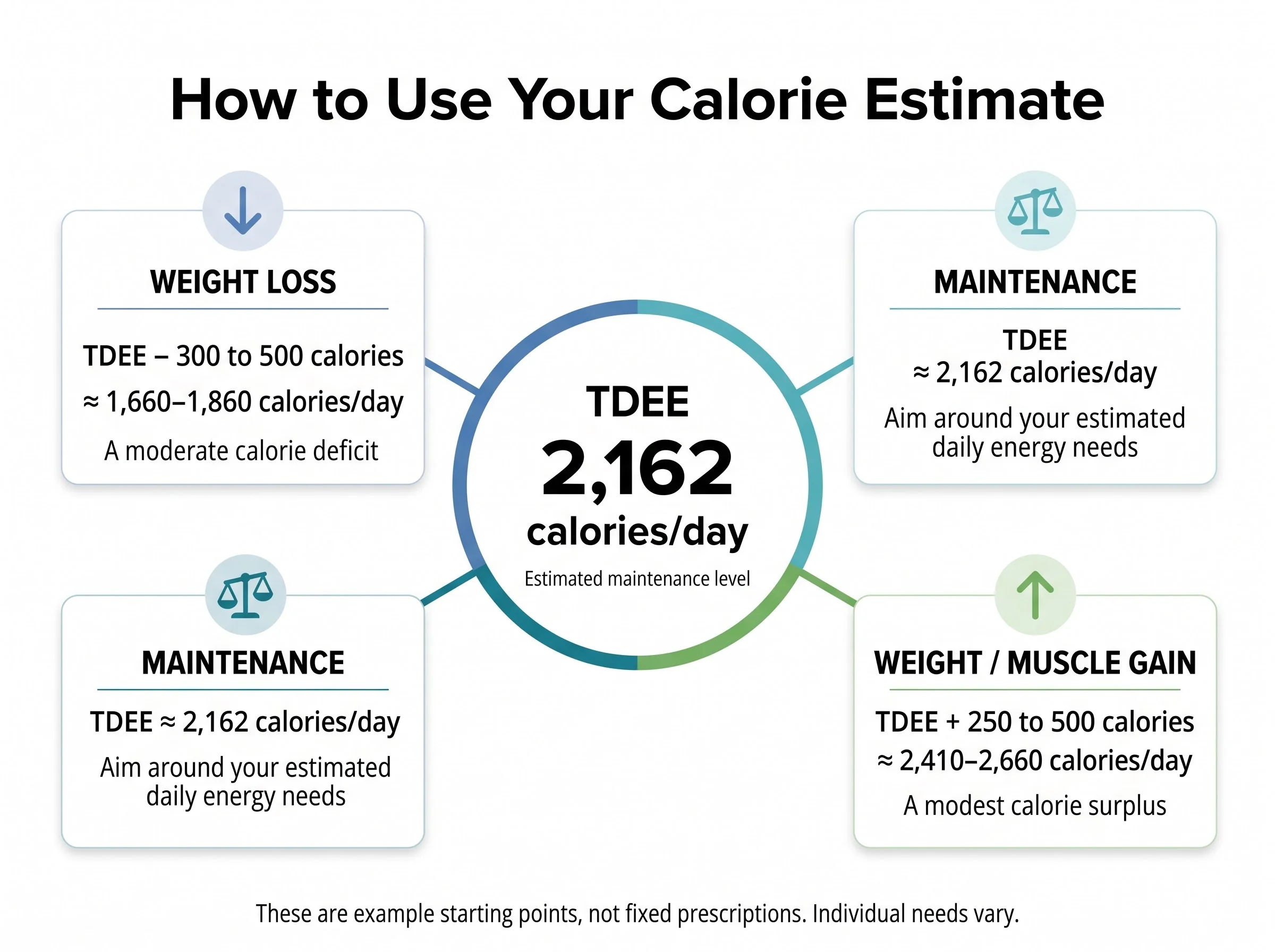
Your calculator result isn’t one number; it’s really three, depending on your goal. Using our 2,162-calorie TDEE example from above:
| Goal | Typical Adjustment | Example Target |
|---|---|---|
| Weight loss | TDEE 300 to 500 calories | ~1,660–1,860 cal/day |
| Maintenance | = TDEE | ~2,162 cal/day |
| Weight gain / muscle gain | TDEE + 250 to 500 calories | ~2,410–2,660 cal/day |
A TDEE of 2,162 doesn’t mean you should eat exactly 2,162 calories forever. It means that’s roughly what your body burns right now, at your current weight and activity level. If you lose weight, your TDEE drops too, since a smaller body generally burns fewer calories. That’s why it’s a starting point you check again from time to time, not a one-time answer.
Factors That Affect Your Results & Calculator Limitations
Several things can shift your real calorie needs above or below what the formula predicts:
- Age: metabolism tends to slow gradually as you get older, partly from natural muscle loss
- Muscle mass: muscle tissue burns a bit more energy at rest than fat tissue does, so two people at the same weight can have different needs
- Hormonal factors: Thyroid conditions in particular can meaningfully raise or lower metabolic rate
- Medications: some can affect appetite, metabolism, or fluid retention
- Sleep and stress: both influence hunger hormones and can shift how many calories you actually burn
And a few honest limitations of the calculator itself: it’s a predictive estimate, not a lab measurement. The same 2005 review found Mifflin-St Jeor typically lands within about 10% of a person’s actual measured needs. That’s better than most alternatives. But it also means a real difference of that size is normal, not a sign anything’s wrong. The calculator also doesn’t know your medical history or exactly how your own body responds to eating more or less. Think of it as a well-informed starting point, not a verdict.
Using Your Number: Weight Loss, Maintenance & Muscle Gain
For weight loss, a daily deficit of around 300–500 calories below your TDEE is a common, sustainable starting point. That roughly translates to about half a pound to a pound of fat loss per week, in line with the gradual pace the CDC generally recommends. That “3,500 calories per pound” math is a rough historical approximation, not an exact science; treat the timeline as a guide, not a guarantee. Diets that go much lower than this can be hard to sustain nutritionally. They’re best planned with a doctor or registered dietitian rather than on your own.
For maintenance, eating close to your TDEE keeps your weight roughly stable over time. Small day-to-day swings are normal; what matters is the average over a couple of weeks.
For weight or muscle gain, a surplus of 250–500 calories above TDEE, combined with resistance training, supports muscle growth without excess fat gain. Protein matters here specifically. The International Society of Sports Nutrition’s position is about 1.4–2.0 g of protein per kg of body weight per day for most people who exercise regularly, noticeably higher than what’s needed for maintenance alone. (Our Protein Intake Calculator can turn that into a daily gram target based on your own weight.)
Common Mistakes & Misconceptions
- Thinking TDEE is fixed. It shifts as your weight, activity, and even the season change; it’s a moving target, not a one-time calculation.
- Cutting far below the calculated number for faster results. This often backfires, triggering more hunger, fatigue, and eventually the exact rebound weight gain people are trying to avoid.
- Counting total calories while ignoring protein. Two people eating the same calories can see very different results in muscle retention and hunger levels depending on protein intake.
- Treating the number as exact. It’s a well-informed estimate. Your actual results over a few weeks are more reliable data than the formula alone.
- Believing “starvation mode” kicks in after one big meal or one missed workout. The real phenomenon is called adaptive thermogenesis; metabolism can drop somewhat during prolonged, severe dieting. It’s genuine, but it’s gradual and modest, not an overnight switch.
- Overlooking NEAT (non-exercise activity thermogenesis). This is the energy you burn from everyday movement outside formal workouts: fidgeting, walking around, taking the stairs. It often drops without you noticing once you start dieting, and that alone can stall progress even with “perfect” tracking.
- Trusting a fitness tracker’s calorie-burned number as exact. Wearables are useful for spotting trends, but they commonly overestimate calories burned during exercise, sometimes significantly.
When Your Results Don’t Match Reality
Sometimes the number doesn’t seem to add up against what’s actually happening on the scale. A few common reasons why:
“Why am I not losing weight in a deficit?” The most common cause is simple: what’s logged and what’s actually eaten have drifted apart. Cooking oil, sauces, and drinks are easy to undercount. Water retention can also hide fat loss on the scale for a week or two. Stress, hormonal cycles, or a recent increase in exercise can all cause this, even when you’re genuinely in a deficit.
“Why do different calorie calculators give me different numbers?” Because they’re not all using the same formula or the same activity assumptions. A tool using Harris-Benedict instead of Mifflin St Jeor, or a more generous definition of “moderately active,” can shift the result by a few hundred calories. Neither is necessarily wrong they are just different estimates of the same thing.
If you’re very overweight or very lean, standard formulas tend to be less accurate at either extreme. That’s because they were built from average population data. If that’s you, treat the number as a rougher starting point, and lean more heavily on adjusting based on your real-world results.
If you’re a competitive athlete or very muscular, a formula based on weight and height alone can underestimate your needs. It doesn’t know how much of that weight is muscle. A body-composition-based formula like Katch-McArdle, which factors in lean body mass directly, is often a better fit.
If you have PCOS, hypothyroidism, or another condition affecting metabolism, your actual calorie needs can differ meaningfully from what any general formula predicts. These conditions are common enough that it’s worth working with a doctor or dietitian to set a target rather than relying on the calculator alone.
When to Consult a Doctor or Registered Dietitian
A calorie calculator is a planning tool, not a diagnosis. Reach out to a doctor or registered dietitian if you notice:
- Unintended, rapid weight loss or gain you can’t explain by changes in eating or activity
- Persistent fatigue, dizziness, or hair loss alongside calorie restriction
- Anxiety around eating, skipping meals to “make up” for other meals, or restricting far below your calculated needs
- A chronic condition like diabetes or a thyroid disorder, where calorie needs can differ meaningfully from a standard formula
- Pregnancy or breastfeeding, both of which change calorie needs in ways this calculator doesn’t account for
Frequently Asked Questions
What is a calorie calculator?
A calorie calculator estimates how many calories you need each day. It uses your age, sex, height, weight, and activity level, based on your Basal Metabolic Rate and an activity multiplier.
How many calories should I eat per day?
It depends on your body and goal, but most adults fall somewhere between 1,800 and 2,800 calories a day for maintenance. Use the calculator above for a number specific to you, rather than relying on a generic range.
What is a calorie deficit?
A calorie deficit means eating fewer calories than your body burns in a day. That prompts your body to use stored fat for the remaining energy; it’s the underlying mechanism behind weight loss.
What’s the difference between BMR and TDEE?
BMR is the calories your body burns at complete rest, with zero activity. TDEE takes that number and adds in your daily movement and exercise, making it the more useful number for actually planning your diet.
Does activity level really affect how many calories I need?
Yes, substantially. Someone who’s very active can need several hundred more calories a day than someone with an identical BMR who’s mostly sedentary.
How many calories do I need to build muscle?
Generally a modest surplus of 250–500 calories above your TDEE, paired with resistance training and adequate protein. Muscle gain needs both extra energy and the raw material to build with.
How accurate is a calorie calculator?
It’s a solid estimate, not an exact measurement. Research comparing common formulas found Mifflin-St Jeor lands within about 10% of a person’s actual measured needs more often than other formulas. Still, any individual can fall outside that range. Treat your first number as a starting point, then adjust based on how your weight actually trends over a few weeks.
Are calorie needs different for men and women?
Yes, on average. This is largely due to differences in typical body size and muscle mass, which is why the Mifflin-St Jeor formula uses separate equations for men and women.
What is a good calorie deficit?
A deficit of 300–500 calories a day is generally a sustainable starting point for most people. It’s enough for steady fat loss without the extreme hunger and muscle loss that come with much larger deficits.
Is 1,200 calories a day enough?
For some smaller or less active women, it can be. But 1,200 calories is very low for most adults. It generally shouldn’t be followed without a doctor’s or dietitian’s supervision, since it’s hard to meet basic nutrient needs at that level.
Can medications affect my calorie needs?
Yes. Some antidepressants, corticosteroids, and hormonal medications can change appetite, metabolism, or fluid retention in ways no calculator predicts. It’s worth mentioning to your pharmacist if your weight shifts unexpectedly after starting a new medication.
Does muscle really burn more calories than fat?
Yes, muscle tissue burns a bit more energy at rest than fat tissue does. It’s one reason two people at the same weight can have different calorie needs depending on body composition though the effect is real, not dramatic.
Related Calculators
- BMR Calculator
- TDEE Calculator
- Body Fat Calculator
- Lean Body Mass Calculator
- Ideal Weight Calculator
- Protein Intake Calculator
- Calories Burned Calculator
- BMI Calculator
Key Takeaways
- Your calorie needs start with BMR (calories burned at rest) and become TDEE once activity is factored in.
- This calculator uses the Mifflin-St Jeor equation. Research has found it lands within about 10% of measured needs more often than other common formulas though your own result can still fall outside that range.
- Weight loss, maintenance, and weight/muscle gain each use the same TDEE number, adjusted up or down by a few hundred calories.
- Treat your result as a starting point check in after a few weeks and adjust based on how your actual weight responds.
- Certain medications, hormonal conditions, and life stages (like pregnancy) can shift real calorie needs beyond what any calculator predicts.
References
- Mifflin MD, St Jeor ST, Hill LA, Scott BJ, Daugherty SA, Koh YO. A New Predictive Equation for Resting Energy Expenditure in Healthy Individuals. American Journal of Clinical Nutrition, 1990. Read it here
- Frankenfield D, Roth-Yousey L, Compher C. Comparison of Predictive Equations for Resting Metabolic Rate in Healthy Nonobese and Obese Adults: A Systematic Review. Journal of the American Dietetic Association, 2005 – the source for the “within about 10%” accuracy figure above
- Centers for Disease Control and Prevention (CDC) – Steps for Losing Weight
- National Institute of Diabetes and Digestive and Kidney Diseases (NIDDK) – Body Weight Planner
- U.S. Department of Agriculture / U.S. Department of Health and Human Services – Dietary Guidelines for Americans, 2025–2030
- Jäger R, Kerksick CM, Campbell BI, et al. International Society of Sports Nutrition Position Stand: Protein and Exercise. Journal of the International Society of Sports Nutrition, 2017. Read it here
Medical Disclaimer
This calculator and article provide general estimates for informational purposes only and are not a substitute for professional medical or nutritional advice. Individual calorie needs vary, and this tool should not be used to diagnose or treat any medical condition. Consult a doctor or registered dietitian before making significant changes to your diet, especially if you have a pre-existing health condition.
Author Box
- Written by: Suvojit, Registered Pharmacist
- Last reviewed: August’26